Ye cannot serve God and mammon
No one can serve two masters, for either he will hate the one and love the other, or he will be devoted to the one and despise the other.
You cannot serve God and money.
(Matthew 6:24, ESV)
No man can serve two masters: for either he will hate the one, and love the other; or else he will hold to the one, and despise the other.
Ye cannot serve God and mammon.
(Matthew 6:24, KJV)
Οὐδεὶς δύναται δυσὶ κυρίοις δουλεύειν· ἢ γὰρ τὸν ἕνα μισήσει καὶ τὸν ἕτερον ἀγαπήσει, ἢ ἑνὸς ἀνθέξεται καὶ τοῦ ἑτέρου καταφρονήσει.
οὐ δύνασθε Θεῷ δουλεύειν καὶ μαμωνᾷ.
(ΚΑΤΑ ΜΑΤΘΑΙΟΝ 6:24)
Warning - this post asks you to read basic Greek. But you will probably learn something even if you can't read the Greek.
The Text in ConText method
Related post: Why Choose Alpha-Omega Greek?
At Alpha-Omega Greek, we believe the best way to learn to understand the Bible in Greek is to see how the words are used in context. We call it the Text in ConText method, and apply it at every level from beginner to advanced.
In this post, we are going to walk through the process of figuring out unknown words from the context of a verse.
Step 1: Reading what you can and looking for clues
If you have studied Greek, you may know enough Greek to read the first phrase of the verse above:
Οὐδεὶς δύναται δυσὶ κυρίοις δουλεύειν· ἢ γὰρ τὸν ἕνα μισήσει καὶ τὸν ἕτερον ἀγαπήσει.
Even if you haven't, some of the words are possibly familiar if you read the transliteration (italics are hints):
houdeis dynatai dusi kyriois douleuein; e gar ton hena misēsei kai ton heteron agapēsei
But even if your Greek is quite good, you may or may not know the words ἀνθέξεται or καταφρονήσει.
No surprise if you don't. ἀνθέξεται is used only 4 times in the New Testament. καταφρονήσει 9 times.
Step 2: Guessing from context
If you are familiar with the verse, you can narrow down the options. The ending phrase "οὐ δύνασθε Θεῷ δουλεύειν καὶ μαμωνᾷ (mamōna)" is a huge clue for those who know the King James version.
ἀνθέξεται and καταφρονήσει must be related to μισήσει and ἀγαπήσει. Which, if you can read the first phrase, I'm guessing you already know.
If you don't know μισήσει, you almost certainly know ἀγαπήσει (agapēsei) and can guess from the context that μισήσει (misēsei) is the opposite of ἀγαπήσει.
Step 3: Recognizing English cognates
If you know the English word misogyny, it is derived from μῖσος misos (hatred) + γυνή gynē (woman).
True cognates are your friends.
Misogynists may not be.
Step 4: Breaking compound words apart
So we have concluded that ἀνθέξεται and καταφρονήσει are likely to be synonyms of μισήσει and ἀγαπήσει, but the question now becomes, which matches which?
You can often get a hint of the meaning of a compound word by taking it apart:
κατα often means against.
φρονέω phroneō means to think (and is a very common word)
So if καταφρονήσει means "think against" it is closer to μῖσος misos (hatred) than to ἀγαπήσει (love).
You can also get a hint from what is called chiasmus, or chiasm.
Chiasmus (chiasm) is a structural clue
In a chiasmus, you have an A B B' A' structure. Superimposed on the Greek letter 'chi' or X.
It looks like this:
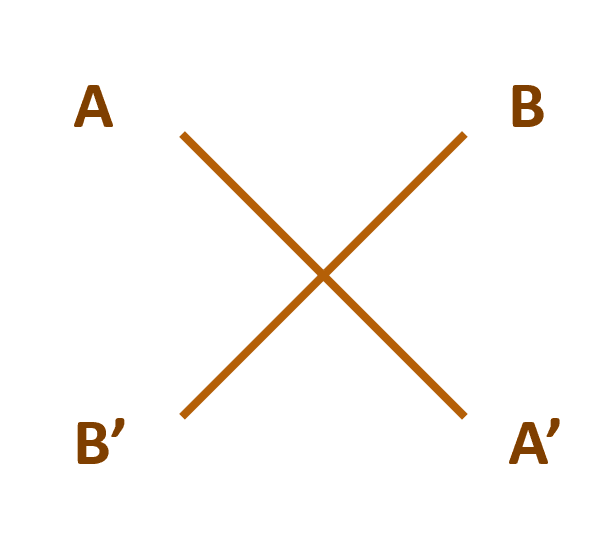
Chiastic structures are very common in Scripture. Think "the last shall be first and the first shall be last" (Matthew 19:30, compare Matthew 20:16)
Inverse parallelism, basically.
Chiasms are memorable and poetic, but are independent of language or sound.
They are very translatable, but are not always translated as chiasmus.
Is Matthew 6:24 chiastic? How does that help?
In our verse above, if you remember a translation like "either he will hate the one and love the other, or he will be devoted to the one and despise the other" it is chiastic. Which tells you the answer to our question of what ἀνθέξεται and καταφρονήσει mean, without looking them up.
As a bonus, chiasmus will help you memorize Bible verses or even Bible passages. Knowing it is a chiasmus helps you remember the order.
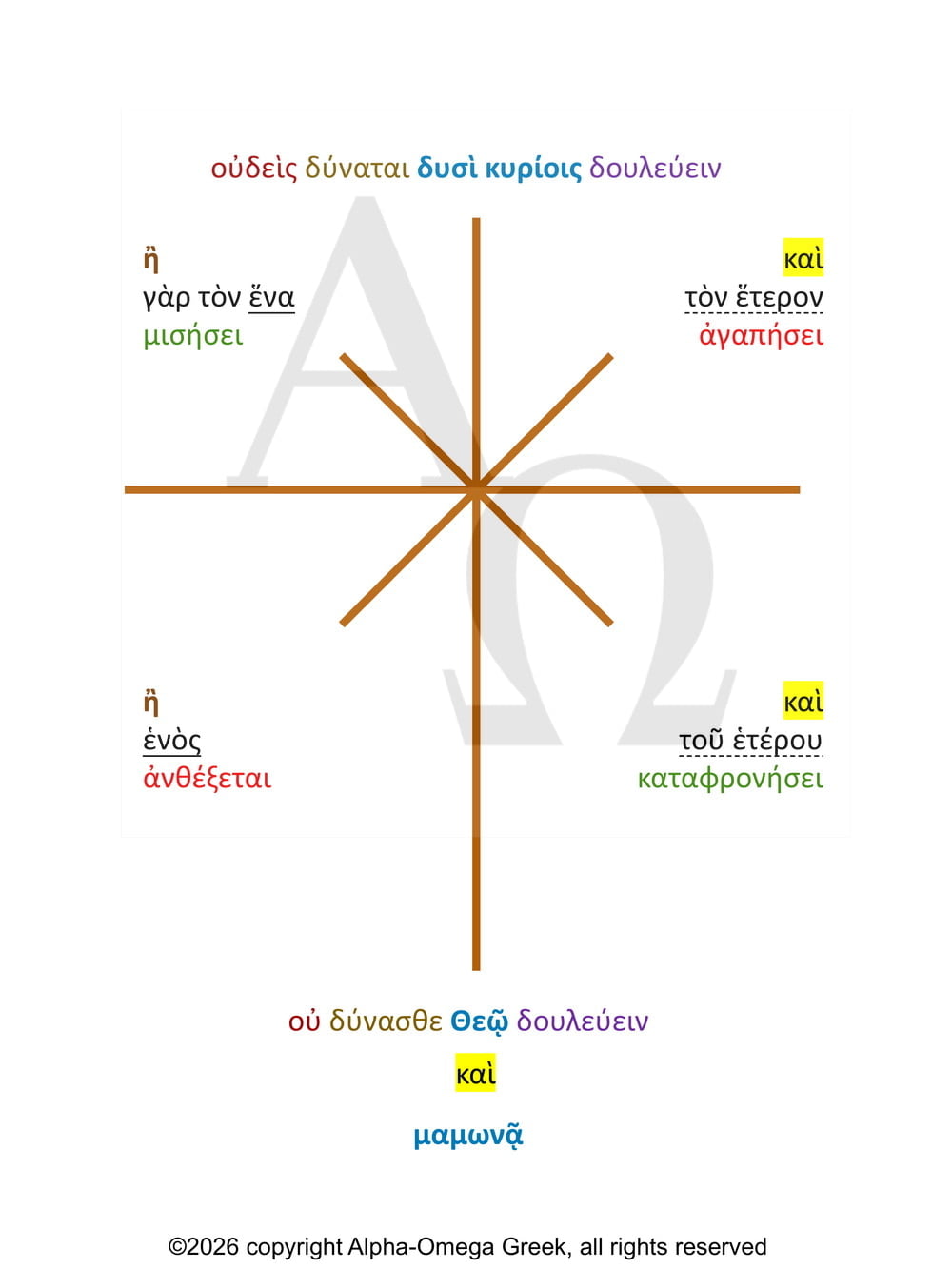
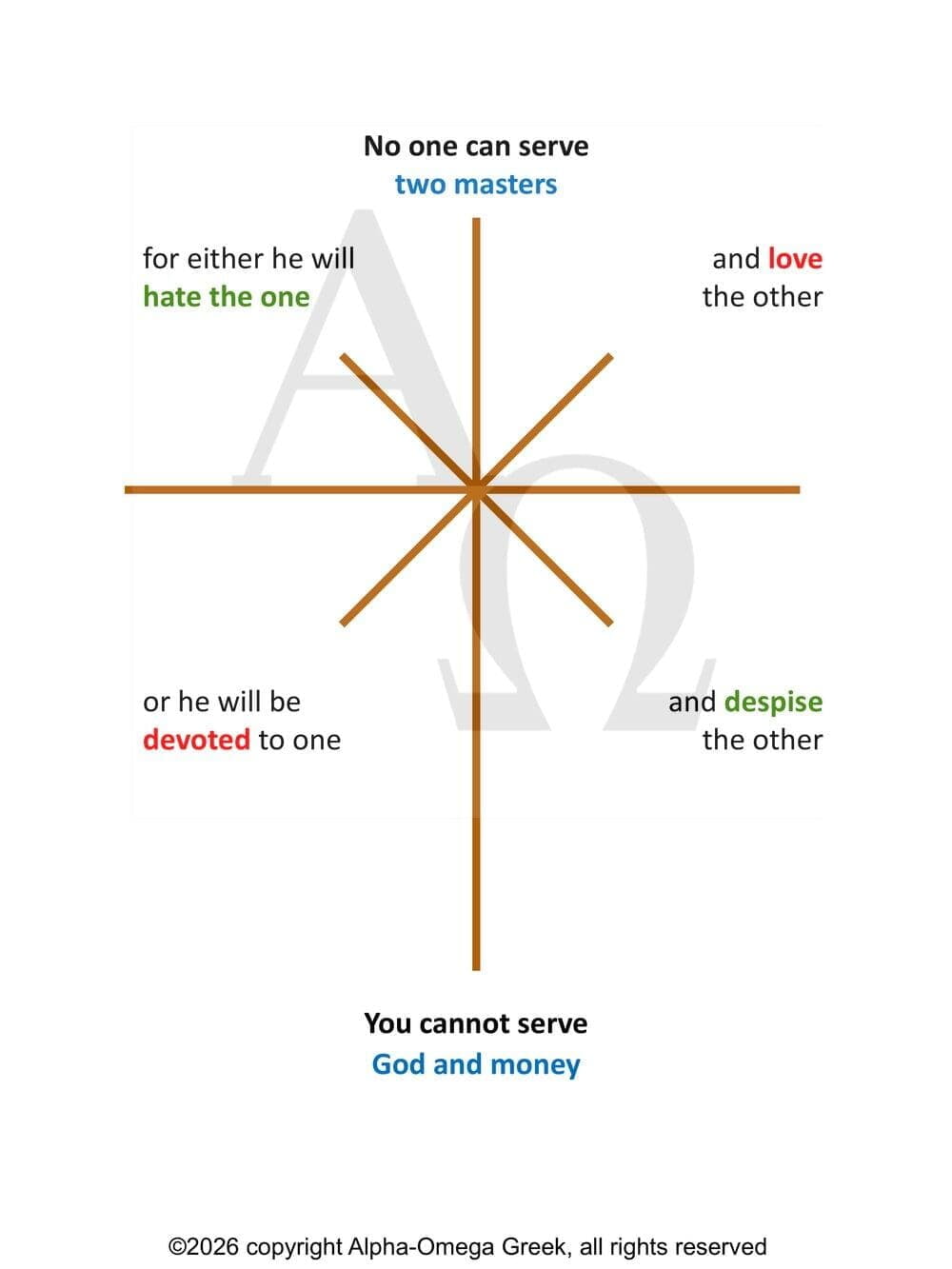
Whether you read Greek or not, does it make more sense now?
Οὐδεὶς δύναται δυσὶ κυρίοις δουλεύειν· ἢ γὰρ τὸν ἕνα μισήσει καὶ τὸν ἕτερον ἀγαπήσει, ἢ ἑνὸς ἀνθέξεται καὶ τοῦ ἑτέρου καταφρονήσει.
οὐ δύνασθε Θεῷ δουλεύειν καὶ μαμωνᾷ.
(ΚΑΤΑ ΜΑΤΘΑΙΟΝ 6:24)
No man can serve two masters: for either he will hate the one, and love the other; or else he will hold to the one, and despise the other.
Ye cannot serve God and mammon.
(Matthew 6:24, KJV)
No one can serve two masters, for either he will hate the one and love the other, or he will be devoted to the one and despise the other.
You cannot serve God and money.
(Matthew 6:24, ESV)
Alpha-Omega Greek Academy
In the Alpha-Omega Greek Academy, we teach you these strategies and help you to use them to read the New Testament itself.
You don't have to wait until you know all the words used at least 4 times in the Greek New Testament to be able to read and understand the real text.
We offer both beginning and intermediate Greek courses to move you from where you are now to where you want to be:
- Reading the New Testament in its original Greek
- And getting to know its Author
You can find out more about our courses here.
By the way, if you know English, you already know quite a lot of Greek. Even if you couldn't read any of the Greek words on this page. (Did you try to read the Greek?) See this series of posts: You already know Greek.
(Literally:
houdeis dynatai dusi kyriois douleuein; e gar ton hena misēsei kai ton heteron agapēsei
no one able two lords serve; or for the one hate and the other love)